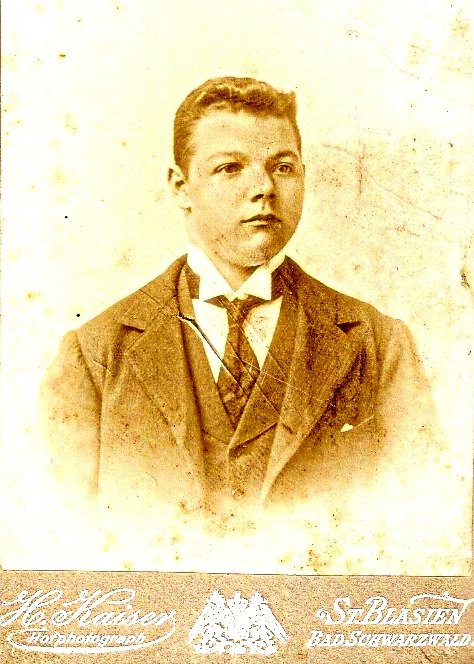
When my great-grandfather met a charming young woman at the opera and borrowed her opera glasses, I wonder if he knew what a departure he was about to take from generations of tradition.
Frédéric Auguste was born in Illkirch, a town in Alsace near Strasbourg, on August 28, 1882. His beloved Toni–born Theresia Antoinette Lordemann–was born on April 7, 1880, just outside of Münster in Germany. That they met at the opera in New York City and married and lived their lives does not seem particularly remarkable in our American melting pot. But for Alsatians at the turn of the twentieth century, it was troubling at best.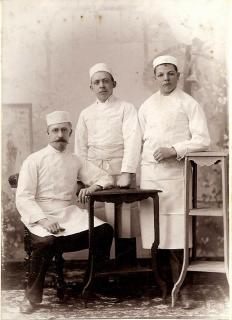
In his 1918 book Alsace-Lorraine, George W. Edwards noted, “Should an Alsatian girl so far forget her vows as to espouse a German, henceforth she was disowned by her own people, and considered as one dead. Thus society dealt with the invader in the two inseparable provinces of Alsace-Lorraine.” I suppose that if that Alsatian girl–or boy–left for the New World and was rarely seen again, the effect on her would be lessened, but this quote certainly reflects the depth of antagonism between Alsace and Germany.
What was the source of this deep animosity? In 1871–only a decade before Gus’ birth– Germany (Prussia) had siezed Alsace and Lorraine. The next fifty years saw what Alsatians considered to be an unending occupation of their country by “invaders.” Considering that the Rhine had historically been the border between Germany and France, and noting also that this area was long ago settled by Gallo-Romans and not Teutonic peoples, it seems logical that the area in question should be considered more French than German. That was indeed the feeling of the native Alsatians, who saw the Germans only as an occupying force.
All of this got me thinking about August’s Alsatian background. My grandmother was very much aware of her Alsatian heritage, and grew up speaking her father’s French as well as her mother’s German. (And English, once she started kindergarten.)
So, I began to research the family line of August Fels.
And I hit a treasure trove!
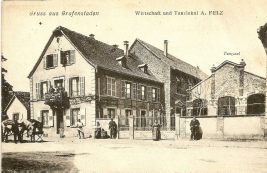
The family inn in Grafenstaden
It turns out that a French historian by the name of Damien Bilteryst has done extensive research on this family tree. I began adding the names to my own tree on Ancestry.com, and was amazed to see the family living in the same little town, Illkirch, all the way back to the 1500’s and beyond. Generations being born, living, marrying, and dying in this picturesque spot on the Ill River. Many fishermen, as well as churchwardens, farmers, straw-cutters, bakers, innkeepers and others. Even a mayor or two.
Some of the earliest in the family lines had their marriages recorded: for example, Jacob Haffner and Maria Heyger, married on 9 February, 1623. He was a weaver. Maria’s father–my 11-great grandfather–was a baker there in the little town of Illkirch. I love that, because my great-grandfather was also a baker, and a chef, and that was part of what drove him to the new world. Another baker in the family tree was Mr. Roesch, my 12-great grandfather born around 1510, who was a “Boulanger de pain blanc”–a baker of white bread. I am currently doing a bit more research on this designation, knowing that there were strict rules governing which bakers could bake which types of bread at various points in history. Another baker was another 11-great grandfather, Wendling Meykuchel, born in 1545. One of his sons, Diebold Meykuchel, born around 1570, was a baker and innkeeper; his other son, Hans Meykuchel, my 10-great grandfather born around 1580, was a “Weißbeck,” a “fancy baker” or confectioner.
The earliest “Fels” ancestor I have traced thus far is Claus Veltz, born around 1547 in Illkirch. (The name changed spelling from Veltz to Fels only a generation or two before my great grandfather, as seen below.) Claus married Susanna Fischer on February 4, 1572, and they had at least three children: Catharina, Sebastian (Nov. 10, 1583- Feb. 3, 1645), and Johannes. Sebastian was my 10-great grandfather, a “bourgeois et pêcheur,” or person living in a town and fisherman.
It is rather amazing to trace the lineage of this one branch of the family tree, and see it going back over ten generations in one town in the banks of the Ill:
son of Claus VELTZ (Fels)
son of Sebastian VELTZ
daughter of Michael VELTZ
daughter of Elisabeth VELTZ
daughter of Barbara Mursch
son of Anna Sengel
son of Diebold Thiebault VELTZ (Fels)
son of Georges Andres Fels
son of Andreas “Andre” Fels
The Fels line weaves in and out of other family lines–Murch, Sengel, Erb, Meykuchel, Schertzer, and others–but it is still striking to see the generations continuing one after another in the same place, and even to this day among the cousins. August would have inherited his family’s land and businesses there in Illkirch, but his round-the-world trip with its unexpected terminus in New York City changed the course of our family history.
So many more stories to tell.
.
 A Continuing Story