Telling Her Story

dorothy title page

My Grandma Dorothy was a storytelling grandma. She moved to Santa Barbara when I was four or five, and babysat us many Friday evenings. I still remember lying in the dark on my bunk bed, Grandma on the twin bed with Kristi, and her voice as she told stories about growing up on the farm in Kalispell. The barn dances, the cold winters, summers on Lake Blaine, caring for the animals, the time the pigs were intoxicated by the rotten apples that she and her siblings threw into the pen.

Those stories would be enough, but they are not all that I have. 

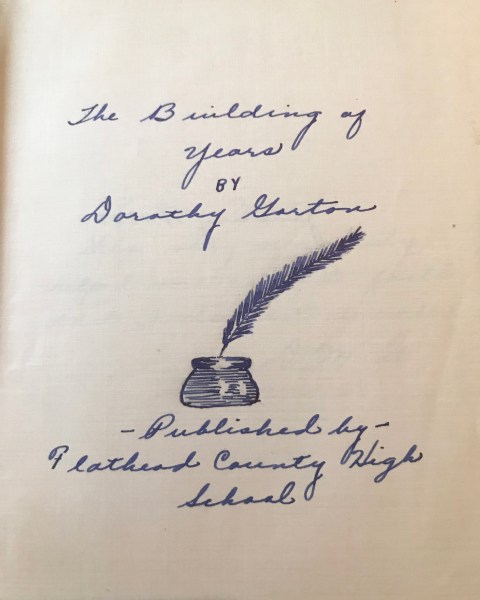
When she was a senior in high school, Dorothy wrote an autobiography for a school project. She entitled it The Building of Years, and in it she chronicled the family history she knew, as well as details from her childhood. It is a priceless treasure.

The book is charming, with its black binding and page after page of her neat script in blue pen. She added a few illustrations in ink, as well as several photos. There are occasional additions on the facing pages as she corrected information or added details later in her life.

She dedicated the book to her mother, who “very sincerely helped me collect facts that I do not remember.” So, I have my great grandmother, Thelma Gorton, to thank as well.  She also writes, “In this book I have preserved facts of my former ancestry and also many little incidents of my life this far.”
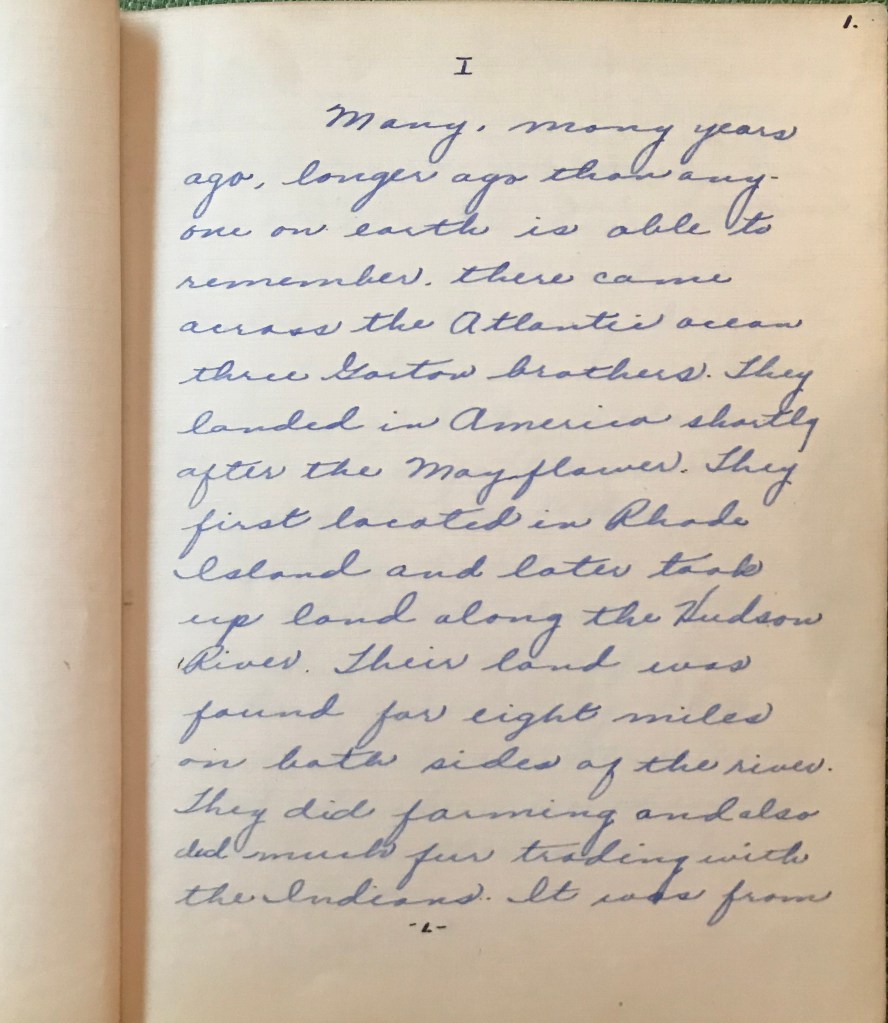
Dorothy begins her book, “Many, many years ago, longer ago than any one on earth is able to remember, there came across the Atlantic ocean three Gorton brothers. They landed in America shortly after the Mayflower. They first located in Rhode Island and later took up land along the Hudson River. Their land was found for eight miles on both sides of the river. They did farming and also did much fur trading with the Indians.” And indeed, this is true. Samuel Gorton arrived in 1636 in New England, with his wife Mary and their three children. His story is well-documented, and has many twists and turns I will describe in another post. I love that my grandmother was aware of this hundreds-year-old history, and celebrated it in her own account.

It is this rootedness in story that characterizes most of my memories of my grandmother. I have another of her journals that chronicles the next chapters of her life, and it is another of my greatest treasures. I spent many months transcribing it, grateful that I learned at an early age to read her scrawling cursive.

Grandma Dorothy’s life on the farm in the twenties and thirties seemed as removed from my own as the Little House books, but she always made the stories live. I am aware, as I read her account of her early life, that my own seems sometimes too current to be interesting–and yet, in fifty or eighty years, it will seem old-fashioned.  I am becoming aware of the value of recording a few details of my own life and experiences, hoping that a future granddaughter will find a connection in trips to the beach, watching scurrying crabs and hermit crabs, or in time spent curled in a chair snuggled next to my giant St. Bernard.

I am also aware of the great family legacy present in story. Not all of the stories are easy or good. Parents and children who died too young, ravaged by disease and war; tales of financial loss at the hands of swindlers or in the wake of failed crops; pain caused by favoritism or misunderstanding. But these experiences and the stories that followed have shaped generations of family, and play their significant role in making me who I am.

From the Coal Mine to the Silver Mines

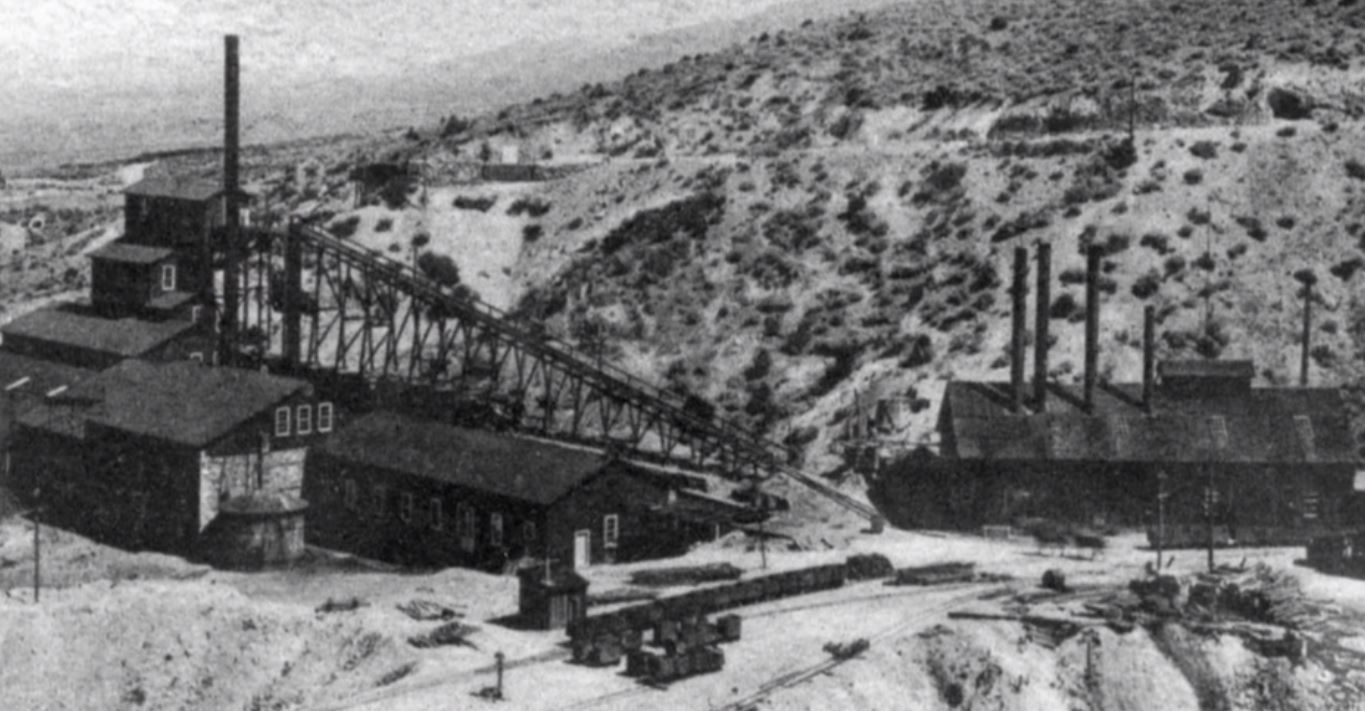
Austin Silver Mine

I was watching a show on Netflix the other day–Ghost Town Gold, in which two guys visit the kinds of ghost towns my family poked around in on vacations. But instead of looking for cool rocks like we did, they go into old barns and buildings and come out with fabulous historical artifacts. In this particular episode (Season 1, Episode 1, around the 30 minute mark), the two hosts explored the town of Austin, Nevada.

Austin rang a bell. Was that where my 3x- Great Grandfather had mined silver? I pulled up the family tree.

But first, a little back story.

On April 12, 1852, nine-year-old William Jenkins arrived in the harbor of New York City on the ship Pathfinder. His family, including his parents William and Elizabeth, brother John (age 14), and sister Anna (age 3), had moved from Wales to seek new opportunities. In her family history, my grandmother recorded: “They settled in St. Clair, Pennsylvania, where his parents lived for the rest of their lives.  His father, William Jenkins, St., died soon after they settled in Pennsylvania, but his mother lived until after she was ninety years old.  She lived in a little white house by herself and always kept a white pig.  She was a very clean old lady and always gave the pig a scrubbing every Saturday.” This last detail is all the more significant when you realize that St. Clair was a coal mining town, and that spotless old lady was a coal miner’s wife.

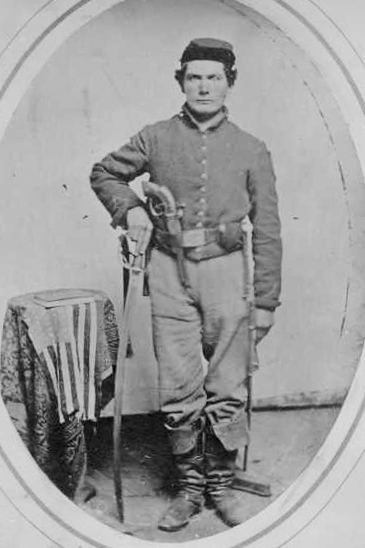
Capt Jenkins Civil WarThe Civil War began on April 12, 1861, when William was eighteen years old. A week and a half later, on April 27, 1861, William enlisted, serving a three-month term with Co. G, 15th Regiment. He then mustered in again as a private in October of 1861 with the Pennsylvania 7th Cavalry, with which he served for the rest of the war. His service record was as follows: Mustered in as private, October 22nd, 1861. Re-enlisted as a veteran, November 1863. Promoted to Corporal, to Second Lieutenant. December 1st, 1864. Mustered in December 18th, 1864, to Captain, July 24th, 1865. Mustered August 10th, 1865. Mustered out with company. Macon, Ga., August 23rd, 1865.  
William Jenkins was eighteen when he began his military career, and twenty-two when the war ended. At some point during or after the war, William married Emma Lewis, whose family had immigrated from England and also moved to St. Clair. Emma’s father was a coal miner, too, and she was listed in the 1860 census as being a seamstress at the age of 16.

While there is little external data for the period immediately following the Civil War for this family, my grandmother’s journal fills the gap. She reports, They made their home in St. Clair and to them were born three children. It was at this time that the West was being opened and the newspapers were headed with “New Gold Mines in  the West,” and “Get Rich Quick in the West.”  As William Jenkins was interested in mining and also to get rich quick, he went to the Tonapah mines in Nevada. The mines looked very successful to him so he sent for his wife and children to come to Nevada to make their home.  Their journey was made by railroads as far as there were railroads, and the rest of the way by stagecoach.  Mrs. Jenkins had heard of the wild West robbers and Indians.  She had a number of gold certificates to bring along and was afraid that she would be robbed of them. After much thinking she sewed them into her baby’s clothes.”

It seems to me that William settled back in St. Clair after the War and they had three children. It is possible that they had been married on one of his furloughs from service. In any case, according to this family history, William and Emma had at least a couple of children before they headed west. The story of Emma sewing the gold bonds into her baby’s clothes suggests that there was at least one child born to them by this point; I wonder if there might have been just one baby who rode the stagecoach with her, or whether she had one or two toddlers in tow as well.

When the family was recorded in the 1870 census, they had settled in Austin, Nevada. (My grandmother’s account above refers to the Tonapah mines, but those were not named and active until about thirty years later.) The census records three family members: William, Emma, and four-month-old Sara Ann, who had been born there in Austin.

What had happened to the other children?

“The town was progressing peacefully until an epidemic of Scarlet Fever swept the country.  There were few doctors and they were many miles from the town.  Many people lost their lives and among them were the three children of Mr. and Mrs. Jenkins. This was a very tragic experience to them and took all of the happiness out of their life for a long time.”  My grandmother goes on to suggest that the reason the family moved to Butte, Montana, was to escape the sadness of the loss of their children.

That may be. I tried for years to get more information on these children–their names, or even simply when they lived. Sometimes I wondered–was this story conflated with that of other pioneer family members?

The 1900 census didn’t shed any additional light. That census was the first which asked women how many children they had borne, and how many of those children were living. The record stated that she had three children, and all were living. This would be Sara (1870), Emma (1874) and Harold (1886).

Then I found the entry for Emma Jenkins in the 1910 census. Her husband had died five years before, and she was living with her son Harold, his wife and young child, and her widowed daughter Sara. Emma’s answer gave me, for the first time, the evidence I was looking for. Number of children: seven. Number living: three.

There they were. No names, no dates, but historical evidence that they had lived and were remembered.

Jenkins headstone

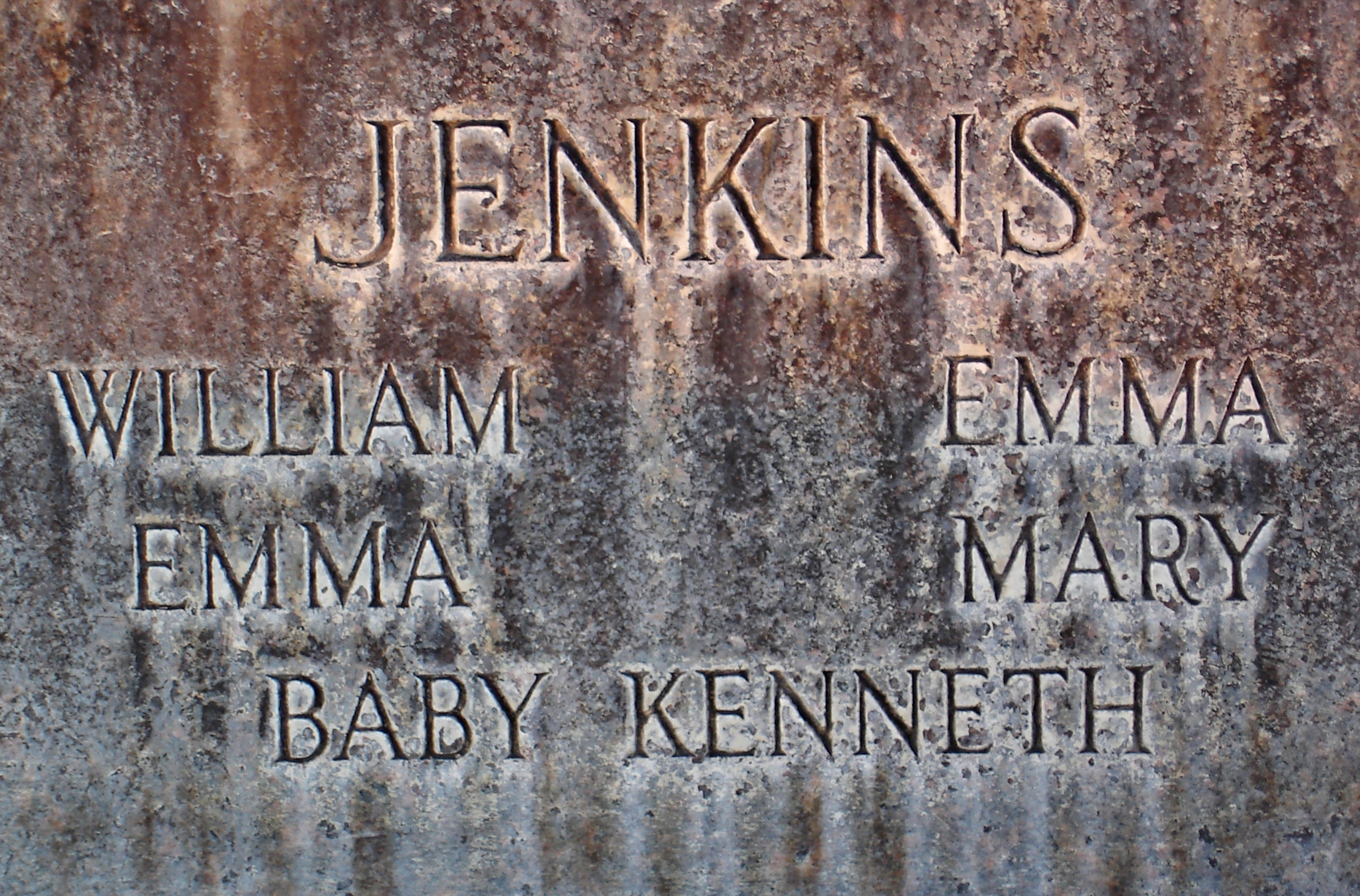
Then I took a closer look at her headstone.

Places for William and Emma.

And then three children: Emma, Mary, and Baby Kenneth.

These are not her grown children. This must be a memorial to the children who were lost: Emma, Mary, and Baby Kenneth.

Somehow, I feel closer to my great, great, great grandmother, knowing that after her husband died, she entered the memory of these little ones into the census record and preserved their names on her tombstone.

Little Soddy on the Prairie

I have been doing more research lately on the lives of my Norwegian ancestors. I happen to be 25% Norwegian, yet I have never had as close a connection to this part of my heritage. So recently I have been examining the lives of these pioneers.

Tollef Tollefson and his wife Anne were born in the 1820’s in Norway, and immigrated to the United States in 1849 after the birth of their first son. After eleven weeks by boat, followed by an overland journey to Wisconsin, Tollef (Ole) and Anne arrived in Spring Valley, Rock County, Wisconsin, August 15, 1849. Their second son, Henry, was born 3 December 1849.  There were seven more children born to the family, all in Wisconsin: Barbra, Martin, Ole, Andrew, Ary, Crist and John. Son Henry married Mary Engen in Wisconsin around 1868; their first son, Sever, was born 16 November 1869.

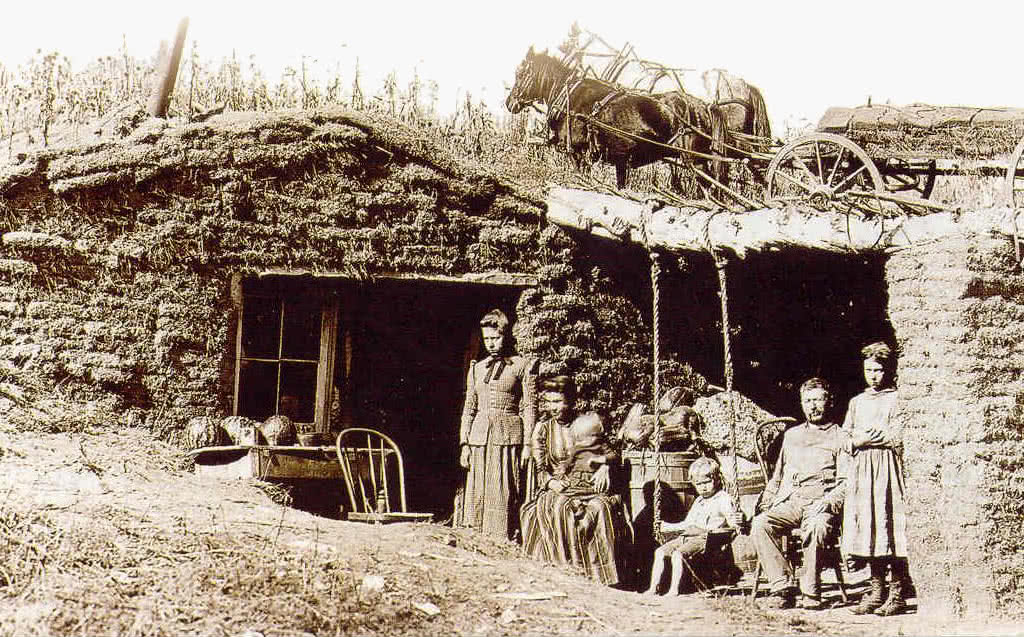
The family’s first home on the prairie was a dugout, similar to the dugout home and stable pictured above. (Photo: Solomon D. Butcher/Library of Congress)

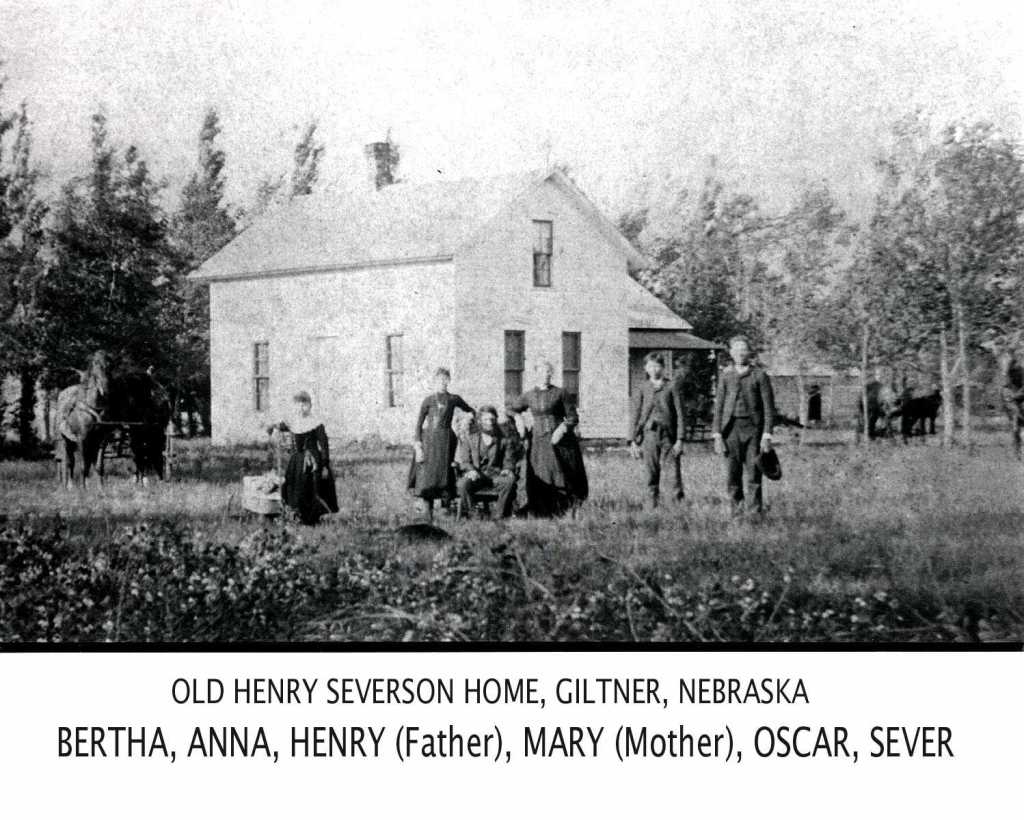
In 1871, Henry Severson moved with his family from Wisconsin to Harvard, Nebraska. According to his daughter, Bertha (Bertie), “In the spring of 1871, they left Wisconsin by covered wagon and ox team for the west–with all their earthly possessions and very little money. When they arrived at a place six miles north of Harvard on a barren prairie they decided this is it.  Their first place of shelter was a dugout back in a bank until Father could break ground with an old breaking plow brought from Wisconsin tied on the wagon.  He built a one- room sod house, laid logs hauled from the river across the top, then sod on top of that for a roof. “

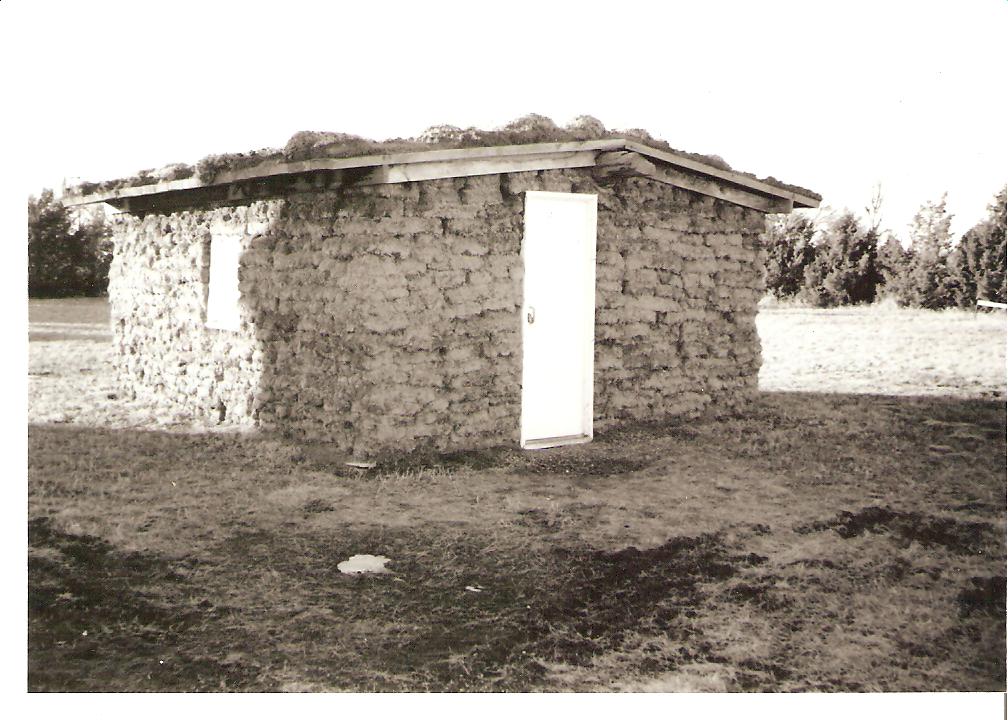
I had always imagined a soddy to be built into the side of a bank or hill, like in Laura Ingalls Wilder’s On the Banks of Plum Creek; but the process of building a soddy involved cutting bricks of sod from the wild prairie, usually 3×4 feet and three inches thick, and then stacking them into a home. There was little timber to be had, and the frame houses couldn’t stand up to the brutal Nebraska winters. The sod houses were warm(-er) in the winter and cool in the summer, and there was no end of material available.

Typical sod house

Bertie notes that the sod house “was where Oscar my next brother was born March 27, 1873; shortly after, while Mother was still in bed, the terrible April storm came, snowed them under and the snow drifted and blew through the roof and down on Mother’s bed.  I shudder when I think of it…” Grandma used to tell this story, handed down from her husband’s family. I can imagine this young woman with a toddler and a newborn baby, huddled on the bed with snow blowing in through every crack.

This storm was one of the worst ever recorded, thereafter known as The Easter Storm, or the Blizzard of 1873. It began on the afternoon of Easter, April 13, and lasted for three days. Snow blew across the prairie like a wall of white. There were no windbreaks yet built, no trees planted to stop the wind, which howled across the prairie and left families buried in their dugouts. Some neighbors were rescued by other pioneer families who only saw a little smoke trailing out of stovepipes sticking up out of the snow. The drifts were 18 to 20 feet in some places, ravines completely filled with snow. Henry, Mary, and their two sons survived the ordeal, and continued to improve their homestead.

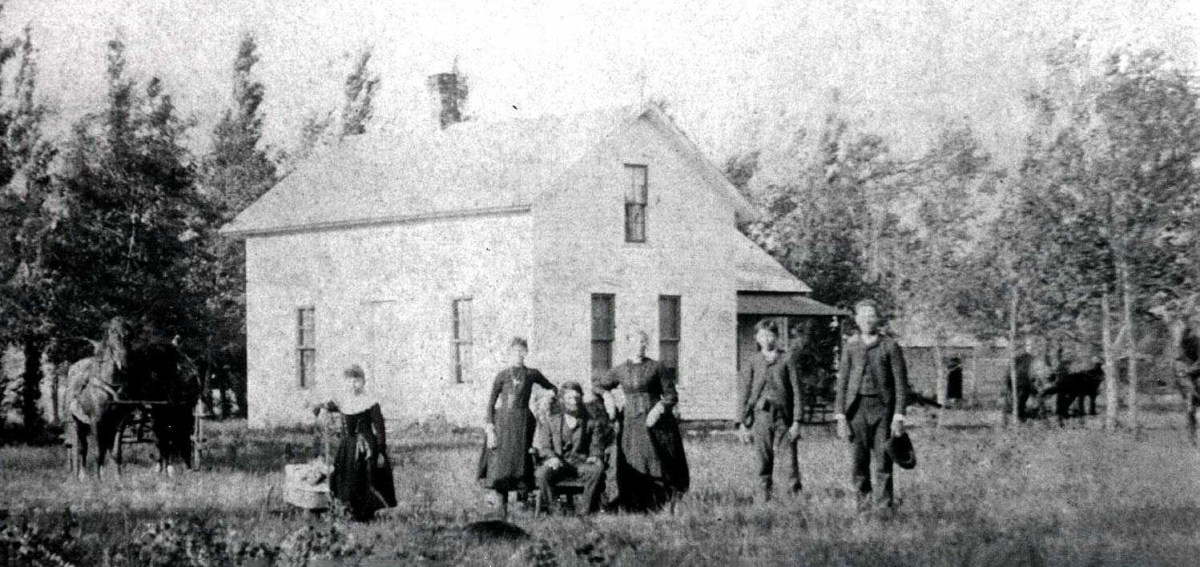
The family eventually built a frame house. Sometimes sod was still used as insulation, with siding built around the sod structure. Henry built a frame house for his family before his daughters were born, and Bertie noted, “A part of our old frame house was built before Annie and I were born, so we can’t say we were born in a soddy.”