https://epicureandculture.com/california-farm-stay/

Ambers Brown

My dad, James W. Brown, served as a judge in Santa Barbara for thirteen years. When researching his branch of our family tree, I discovered that he was not the first judge in the family who served the people of California. Ambers Brown, born in Iowa in 1849, became a Justice of the Peace in Tranquility, California, in the beginning years of the twentieth century.

As a family historian, I spend a lot of time attempting to flesh out skeletal stories provided by census data, dates in family Bibles, and the occasional newspaper article. But one of the best finds I ever had was an article tucked into one of my Grandma Dorothy’s journals which provided not only some wonderful details about the life of Ambers Brown, but also a few other clues into the family history.

I’m going to post this glowing article below for the benefit of others researching this branch of the Brown family. The article comes from a book by Paul E. Vandor entitled History of Fresno County, California: With Biographical Sketches … Volume 1. This account provided not only information on Ambers and his wife, Mary Pike, but both of their sets of parents and their places of birth.

Ambers Brown. –The popular and efficient Justice of the Peace of the First Judicial Township of Fresno County, Judge Ambers Brown is an able, conscientious and impartial dispenser of justice, whose wise counsel and advice are eagerly sought by the residents of Tranquility and vicinity.  Judge Brown is a native of the Hawkeye State, born in Washington County, Iowa, June 3, 1849, son of James and Agnes (Johnson) Brown.  His father was a native of Kentucky who moved to Indiana, where he married Agnes Johnson, a native of the Hoosier State, and they migrated to Iowa about 1845 where they were among the early pioneers of Washington County.  The Indians were still to be seen in the country when Mr. Brown located in Iowa.  He improved a farm and followed farming until his death in 1878, and his wife passed away in 1855. [Note that Ambers’ mother died when he was just six years old. His father remarried.] James and Agnes Brown were the parents of three children, Judge Ambers Brown being the only member of the family living.  He remained at the Iowa home until he was twenty-one years of age, when he was united in marriage with Miss Mary Pike, a native of the Buckeye State, born near Columbus, Ohio.  She came with her parents, Jonathan and Louisa (Umbel) Pike, to Iowa.  They were pioneer farmers of the Hawkeye State.

In 1875, Mr. and Mrs. Ambers Brown removed to Hamilton County, Nebr., where they homesteaded eighty acres of land, twelve miles from Aurora, on the Little Blue River. Mr. Brown broke up the virgin prairie soil, and raised corn, wheat and stock, continuing his operations in this locality for about twelve years, when he sold his farm and returned to Fremont County, Iowa, where he followed farming for four years.  In 1891 Ambers Brown decided to migrate to the Golden State, and after arrival in California, he located at Dos Palos, where he purchased twenty acres and improved it by planting alfalfa and fruit trees, and also engaged in dairying.  While living there he was honored by being elected to the office of justice of the peace and also served as school trustee.  In 1910 he sold his ranch and located at Tranquility, Fresno County, where he purchased twenty-two acres.  The land was raw and unimproved, but Mr. Brown soon leveled and checked it, set out an orchard, planted alfalfa, built a residence, engaged in dairying and raising hogs and cattle.

In 1914 he was elected justice of the peace of the First Judicial Township of Fresno County, after which he moved into the town of Tranquility and bought his present home, and has established an office on the same lot, renting his ranch for three years. In 1918 Judge Brown was reelected, evidence of the satisfactory manner in which he had conducted the affairs of his office.  He is also notary public and grain-buyer for Gen. M. W. Muller Company, of Fresno.  Judge and Mrs. Brown are parents of two children: Dennis V., the owner of a ranch at Tranquility; and Robert E. residing in Hamilton County, Nebr., where he is a farmer. [Note: Robert and his wife Anna (Severson) had four sons and one daughter; their youngest son was my grandfather, Jesse Willard Brown.]

Judge and Mrs. Ambers Brown are active members of the Church of Christ and were instrumental in the organization of the congregation at Tranquility, aiding substantially in building the house of worship, the Judge being a member of the building committee and a trustee.  Judge Brown is an exceedingly pleasant and affable man and is highly esteemed in the community.

I am biased, my dad being one of my favorite people anywhere in the world. But I know I am not alone in thinking him also “exceedingly pleasant and affable” and “highly esteemed in the community.” I feel a kinship with his great-grandfather, and look forward to meeting him one day.

 

Facing mortality

I think one of the most sobering parts of researching family history is seeing the rate of infant, child, and maternal mortality, and thinking about the family implications. It’s true that mortality was a much more common part of life in the seventeenth or eighteenth century; you expected that not all of your children would live to adulthood, and you might not live to a ripe old age. Yet each family had a story, and as I enter in dates and names, I think about them.

Take Anna Goertz Sengel, born in 1681 in Illkirch. She married Diebold Sengel at the age of twenty on 21 February 1702, and they had their first child, Margaretha, on 28 September of 1704; Margaretha died just shy of her fifth birthday on 21 September 1709. Their second daughter Anna was born on 6 February, 1708, and passed away the next day. Their third daughter Maria was born on 20 October, 1711, and died three weeks later. Their fourth child, a son named Diebold, born January 4, 1713, was their only child to survive to adulthood (my 6-great grandfather). Fifth child Catharina was born on 24 February, 1717; she died at the age of seven. Sixth child, Anna, was born 24 February 1720, and outlived her mother, the only one of the daughters to do so; even so, she died when she was nine. Seventh child Maria was born 20 September 1722 and died on 3 December of the same year, and their final child, Salome, was born on 10 August 1724, and died on the same day as her mother Anna, 5 October, 1724, three weeks after seven-year-old Catharina.  A whooping cough epidemic in Alsace in 1724 may be to blame for the death of mother and these two children, though the family was clearly plagued by ill health in general, losing seven of their eight children between 1704 and 1729.

Diebold took a second wife a year later, marrying Anna Michel on 13 May 1725, but he died on 1 March, 1726, leaving his wife pregnant with twin boys who were born on the first of September. One of the boys, Johannes Georg, died before his second birthday, but the other twin, Johann Michael, lived until the relatively advanced age of 59.  Thus of the ten children of Diebold Stengel, only two survived to adulthood: my 6-great grandfather Diebold, and his half-brother Johann Michael.

The next generation faced similar tragedy. Diebold was a fisherman, and he married Barbara Mursch on 12 March 1737. Their son Diebold was born 28 September 1738; he died just before his fifth birthday. Their second son, Georg, only lived three years. But their daughter Anna, my 5-great grandmother, was born 1 April 1748 and lived until she was seventy-three.

Diebold’s half-brother, Johann Michael, became a cooper and innkeeper at “The Swan” in Illkirch (Cygne).  His first wife was Margaretha Steuer; their son Johann Michael was born 27 April, 1749.  She died when their son was only six months old; he married again, but he and his second wife, Barbara Walther, had three sons who did not live past their second birthday. So, of this generation, only two of the seven children survived to adulthood.

Johann Michael’s only living son, Johann Michael II, went on to accomplish a great deal in his life: he was a cooper; he continued his father’s role as the innkeeper of The Swan; he was the mayor of Illkirch from 1790-1793, and he was the Chief Commissioner in Geispolsheim.  He married Anna Maria Goertz around 1767 and they had four sons and one daughter.  But the same infant mortality seen in the previous generation continued: his first son, Johann Michael, died before his second birthday. Happily, their daughter, Anna Maria, lived a relatively long life (1771-1822). Their third child, also named Johann Michael, lived only two weeks. Their fourth child, the third Johann Michael, lived to adulthood and continued the tradition of being the innkeeper of The Swan.  Their fifth child also lived to adulthood; he was named Johann Georg, after his grandfather’s twin brother, and lived as a farmer in Illkirch.

Similarly, Diebold’s daughter Anna, my 5-great grandmother, bore six children and saw four of them survive to adulthood.  Andreas (1767-aft. 1798) became a fisherman and innkeeper and had four children; Diebold died at age 5; Anna (1773-1835) married and had one son; Diebold (1777-1851, my 4-great grandfather) was a day laborer and saw six of his eight children live to adulthood; Anna Maria died at the age of eight; and Margaretha (1782-1826) married and had five children. Only one, however, lived to be an adult.

I am not sure whether there was a particular genetic trait that wreaked havoc with these families, or whether it was simply living in a time of disease, war, and hardship. As I research other branches of the family, I’m sure I’ll have a better sense. But as I read through the names and saw infant siblings and uncles and aunts remembered by surviving family members, it seemed to me that, regardless of the common nature of infant mortality, each child was still mourned and remembered. It makes me feel humbled to think of how many times my ancestors were one of only one or two surviving children; humbled, and grateful.

The Chef

1240154_10151581028941776_1136157854_n.jpg

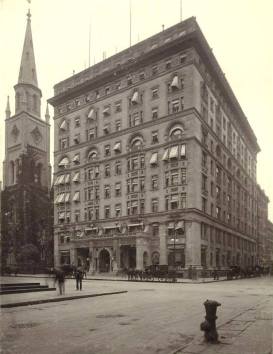
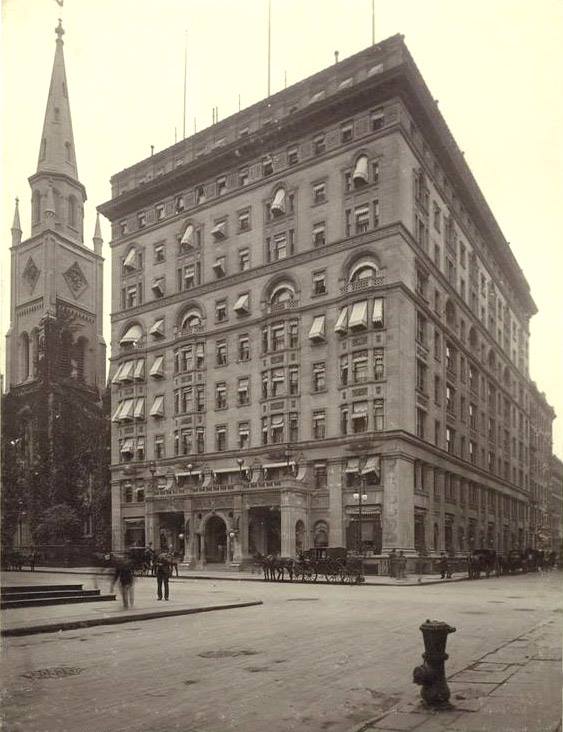
The Holland House Hotel, 30th and 5th

My Grandma Harley told me many stories of her parents.  Her father, Frederich August Fels arrived in New York City on May 6, 1906, on the Philadelphia. The passenger list indicated that he was headed to work at the Holland House Hotel at 30th and 5th Avenue, one of the finest hotels of the day.


Trained in Paris, Gus was a fine chef, and his plan was to tour the world before settling down to take over the family hotel and restaurant in Graffenstaden.  His plans changed, however, when he met Antoinette Lordemann at the opera one evening. He asked to borrow her opera glasses; they married on October 4, 1910.


The Holland House Hotel closed in 1920. Prohibition had an unintented consequence for the hotels and restaurants of New York; without wine lists and the income from other alcoholic beverages, they went under.  Gus was no longer working at the Holland House when it closed; by 1915, he was listed in the census as the head of the household at 402 8th Avenue, a three-story building with a restaurant and bar on the first floor. The other members of the household were Toni and their daughter Henrietta (Rita), my grandmother, who had been born December 9, 1911. The rest of the house was rented to ten roomers, many of whom were possibly employed by Gus: four waiters, a cook, a kitchenman, and a porter. (There were also a lawyer, a machinist, and a driver rounding out the boarders.)

At some point between 1916, when Rita’s brother Frederich was born in New York City, and 1920 when the Federal Census lists them at the home on Somerset Street in Philadelphia, Gus’ business failed. I have heard it said that he was too trusting, got into trouble with creditors, and fled to Philadelphia to start over. I am curious what role WWI and Prohibition might have played in its downfall, if any. Gus, in his mid-thirties, did not fight in WWI; being German and French, the family worked hard to prove their patriotism in their new home in Philadelphia. They had been American citizens for years; young Fritz became Fred only, and Rita spoke English in her new Kindergarten.

More to come…