The Chef

1240154_10151581028941776_1136157854_n.jpg

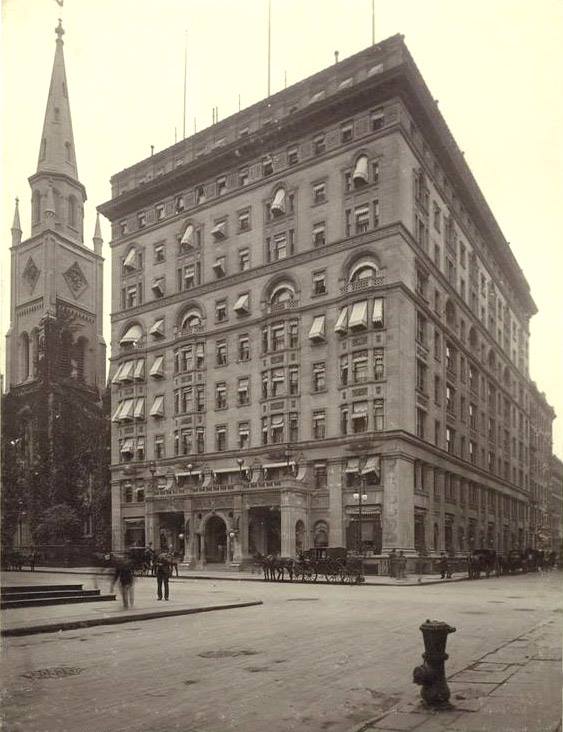
The Holland House Hotel, 30th and 5th

My Grandma Harley told me many stories of her parents.  Her father, Frederich August Fels arrived in New York City on May 6, 1906, on the Philadelphia. The passenger list indicated that he was headed to work at the Holland House Hotel at 30th and 5th Avenue, one of the finest hotels of the day.


Trained in Paris, Gus was a fine chef, and his plan was to tour the world before settling down to take over the family hotel and restaurant in Graffenstaden.  His plans changed, however, when he met Antoinette Lordemann at the opera one evening. He asked to borrow her opera glasses; they married on October 4, 1910.


The Holland House Hotel closed in 1920. Prohibition had an unintented consequence for the hotels and restaurants of New York; without wine lists and the income from other alcoholic beverages, they went under.  Gus was no longer working at the Holland House when it closed; by 1915, he was listed in the census as the head of the household at 402 8th Avenue, a three-story building with a restaurant and bar on the first floor. The other members of the household were Toni and their daughter Henrietta (Rita), my grandmother, who had been born December 9, 1911. The rest of the house was rented to ten roomers, many of whom were possibly employed by Gus: four waiters, a cook, a kitchenman, and a porter. (There were also a lawyer, a machinist, and a driver rounding out the boarders.)

At some point between 1916, when Rita’s brother Frederich was born in New York City, and 1920 when the Federal Census lists them at the home on Somerset Street in Philadelphia, Gus’ business failed. I have heard it said that he was too trusting, got into trouble with creditors, and fled to Philadelphia to start over. I am curious what role WWI and Prohibition might have played in its downfall, if any. Gus, in his mid-thirties, did not fight in WWI; being German and French, the family worked hard to prove their patriotism in their new home in Philadelphia. They had been American citizens for years; young Fritz became Fred only, and Rita spoke English in her new Kindergarten.

More to come…


Orphan Train

It has been a few months since my last blog post, because that post inspired me to dive back into some tricky research. But last night I finished reading the novel Orphan Train and figured I should record what I have learned so far about my own orphan train story.

My Grandma Dorothy grew up on a farm in Kalispell, Montana, at the foot of Glacier National Park. Her grandmother Hattie lived in a small house down the road.

Hattie was born in New York City in 1859 (April 1 according to some records). In 1860, the census records that a two-year-old named Hattie Washington was living with the Irish Durnin family: Patrick and Catherine, and their boys Michael (1840, Ireland); Patrick (1850, England); and George (1852, NYC). There is another baby with a different last name also living with the family.

Whether this Hattie is my Hattie or another is a question, one I don’t see easily remedied unless I can find a record of her adoption. Hattie Washington, born 1859, was also put on the orphan train to go west in search of a family who would raise her.  The train was headed to Hanover, Jefferson County, Indiana. (Marjorie Mills provided this information, who I later discovered was her granddaughter through her son Harrison.)

What I know for certain is that in 1870, Hattie was living with her new, adoptive family in Geneva, Jennings County, Indiana. She shared their last name, and on first glance one might think that she was simply the last-born daughter. But then you take a closer look and realize that Betsy was 52 when Hattie was born, and her husband, the Reverend Timothy Jayne, 54. In fact, Thomas and Betsy had already raised five sons and three daughters, all of whom had left home before the 1870 census.

I have not yet uncovered when it was between 1860 and 1870 that Hattie was adopted.  A search of the Jennings County Courthouse records did not return any results (thank you, though, Sheila Kell for looking!). My next step is to try to research through the records of those searching for Orphan Train riders and their descendants, or possibly the records of the Children’s Aid Society.